Russian
 English
 Arabic
 French
 German
 Italian
 Spanish
Aluminum Die Casting Advantages and Disadvantages
Алюминий литьё под давлением forms complex, thin-walled parts at a production rate few other metal-forming processes can match, and it backs that speed with tight tolerances and a smooth as-cast surface. The same process carries high tooling costs, unavoidable porosity, and firm limits on part size. This guide weighs the advantages and disadvantages of aluminum die casting, compares the process with sand casting, and identifies the projects that justify the tooling investment.
What Is Aluminum Die Casting?
Литье алюминия под давлением is a metal-forming process in which molten aluminum alloy is forced under high pressure into a reusable, hardened steel die, where it cools and solidifies into the final part geometry. The die opens, the part ejects, and the same die closes again for the next cycle. Die casting involves four main steps, which keeps the incremental cost of each additional part low.

Aluminum alloys are processed on cold‑chamber die‑casting machines. Molten aluminum picks up iron from the ferrous components used in hot-chamber injection systems, so the metal is melted in a separate furnace and transferred to the unheated shot chamber for each cycle. That transfer step makes aluminum cycles slower than the hot-chamber cycles used for zinc. The same high-pressure injection is also what fills thin sections and fine detail before the metal solidifies.
Scojet provides aluminum alloy die casting as one of its core manufacturing services, from mold development through casting, machining, and finishing.
Advantages of Aluminum Die Casting
Complex, thin-walled geometry. High-pressure injection fills difficult-to-reach thin sections in a single shot, and aluminum retains high dimensional stability in very complex shapes.
High production efficiency. Fast, automated cycles and reusable steel dies support high-volume output programs; a settled die and process settings repeat part dimensions and surface quality with little variation.
Low unit cost at volume. Because the die is reused and the process runs on four steps, the cost per part falls steadily as production volume grows.
Smooth as-cast surface and tight accuracy. Die castings deliver a very good surface finish by casting standards and consistent dimensions, which reduces the machining required before parts ship or assemble.
Light weight with useful strength. Aluminum alloy density sits near 2.7 g/cm³, well below steel and copper alloys, while castings keep good mechanical properties — including strength retention at moderately elevated temperatures.
Corrosion resistance and thermal conductivity. Aluminum alloys resist corrosion in harsh environments and move heat efficiently, which suits housings, heat-dissipating enclosures, and outdoor equipment.
Consolidated features. Ribs, bosses, mounting holes, and cast-in inserts can be produced in the die, replacing multi-part assemblies with a single casting. Fewer component joints also mean fewer fasteners to stock and fewer seam paths to inspect.
Disadvantages of Aluminum Die Casting
High tooling cost and lead time. The hardened steel dies and casting machines represent a large capital investment, which limits the process to high-volume production. Design changes after the die is cut are expensive, and the die must be built and tested before the first production part.
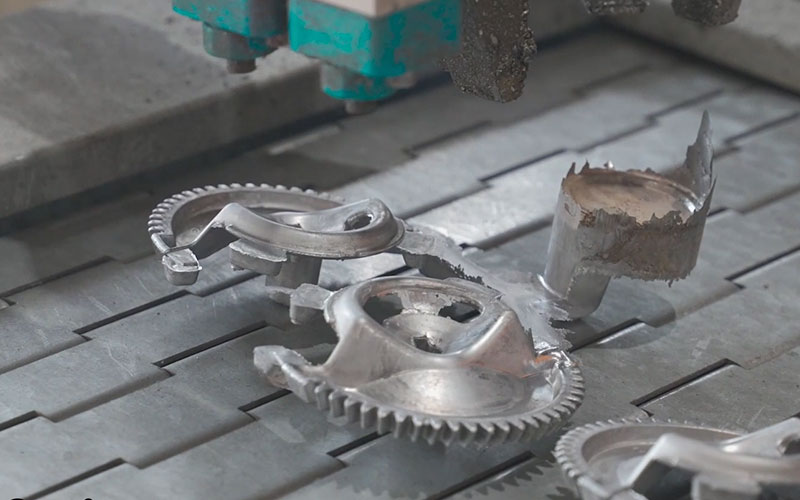
Porosity cannot be fully eliminated. The rapid fill that fills thin sections also traps air; vents along the parting line reduce the problem, but even a highly refined process leaves some porosity in the center of the casting. Gas porosity and shrinkage porosity appear among the common die casting defects, which matters for parts that must hold pressure or seal.
Practical size and section limits. Common practice has capped aluminum die castings around 70 lb (32 kg) per part, with very large machines exceeding 100 kg(220 lb) only for specialized automotive structural parts. Wall sections are also best kept below about 13 mm (0.5 in); thicker sections raise shrinkage-defect risk.
Design constraints. Die castings need draft angles for ejection, generous draft on holes and windows, fillets at corner junctions, and a workable parting line — geometry that designers of machined or sand-cast parts may not have to consider.
Slower aluminum cycles. The cold-chamber transfer step makes each aluminum cycle slower than a zinc hot-chamber cycle, so aluminum loses part of die casting’s speed advantage.
Poor fit for low volumes. At prototype or low quantities, the tooling investment dominates part price; sand casting typically serves those orders more economically.
Aluminum Die Casting vs. Sand Casting: Which Process Fits Your Project?
Both processes start with molten aluminum. Die casting injects it under pressure into a permanent steel die; sand casting pours it by gravity into a single-use sand mold formed around a pattern. Each process dominates a different side of the volume decision:
| Factor | Aluminum Die Casting | Литье в песок |
| Tooling cost | High — hardened steel die | Low — pattern and sand |
| Best volume | Medium to very high | Prototypes to low/medium volume |
| Per-part price at volume | Falls steadily | Stays comparatively flat |
| Surface finish and accuracy | Smooth, tight | Rougher, looser |
| Large or thick parts | Limited by machine and die size | Well suited |
The decision usually comes down to volume and part size. When annual quantities reach the thousands and the part has thin walls, tight features, or a finish that reduces machining, die casting’s per-part savings repay the die. When the order is a prototype, a large casting, or a design with complex internal cavities that sand cores form easily, sand casting is the more economical route. For a factor-by-factor comparison, see Aluminum Die Casting vs. Sand Casting: What Is the Difference?
When Aluminum Die Casting Is the Right Choice
Aluminum die casting fits programs that combine volume with geometry: motor housings, turbocharger housings, EV charging-pile enclosures, pump covers, and structural automotive components all pair thin walls and integrated features with production quantities in the thousands or more. Robot bases, explosion-proof enclosures, and medical equipment housings follow the same pattern across other industries. When those conditions hold, the process delivers parts that are light, accurate, and nearly finish-ready straight from the die.
Scojet’s die casting services cover aluminum, zinc, and magnesium programs from mold development through high-pressure casting, CNC machining, surface finishing, inspection, insert installation, and assembly. Cold-chamber machines from 150 to 800 tons run aluminum alloys including A360, A380, A383, and ADC12. A356 is available for gravity/low‑pressure casting processes; quality systems include ISO 9001:2015, ISO 14001:2015, and IATF 16949:2016, with annual capacity around 10 million pieces.

Frequently Asked Questions
Is Aluminum Die Casting Cheaper Than Sand Casting?
Per part at volume, yes — unit price falls as production amortizes the steel die. For prototypes, large parts, or low quantities, sand casting costs less because its tooling is a pattern rather than a hardened die. Comparing total program cost, not part price alone, shows which process fits a specific project.
Why Does Aluminum Use Cold-Chamber Die Casting Machines?
Molten aluminum attacks the ferrous components in hot-chamber injection systems and picks up iron, so the metal is melted in a separate furnace and transferred to the shot chamber for each cycle.
Can Die-Cast Aluminum Parts Be Made Pressure-Tight?
Vents and careful gating minimize trapped air, but some center porosity remains in most die castings. Parts that must hold pressure or seal are achievable when the requirement is defined early: die-design options and any secondary sealing steps for the project can be agreed with the supplier during quotation.
Get a Quote for Your Aluminum Die Casting Project
Share your drawings, alloy preference, and expected volumes, and the Scojet engineering team will review the part and return a quotation — quick quotes cover orders from 1 to 1,000 parts. Связаться с компанией Scojet to start.