
 English
  Arabic
  French
  German
  Italian
  Russian
  Spanish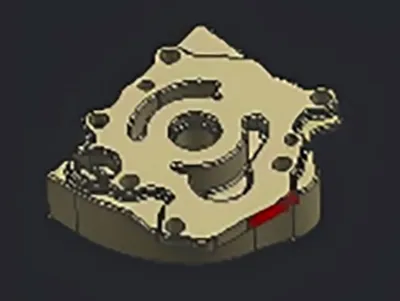
Case Overview
This case involves a Pump Cover, a key sealing cover component used in the automotive industry, specifically in automotive pump assemblies such as oil pumps, water pumps, hydraulic pumps, or steering pumps. The pump cover is installed on the end face of the pump body and works together with the pump body to form an enclosed pump chamber. It performs a sealing function while also helping control the flow path inside the pump.
Since automotive pump products operate for long periods under high-temperature, high-pressure, and vibration conditions, the pump cover must meet strict air tightness requirements. Defects that may cause leakage, such as through-porosity, shrinkage porosity, or microcracks, are not permitted.
The pump cover is die-cast using a standard/general-purpose mold and delivered after shot blasting.
Part Information
| Item | Parameter |
| Part Name | Pump Cover |
| Application Industry | Automotive (Pump Assemblies) |
| Material / Grade | ADC12 |
| Product Dimensions | 112 mm × 122 mm × 28 mm |
| Average Wall Thickness | 3.5 mm |
| Maximum / Minimum Wall Thickness | 3–4 |
| Product Weight | 176 g |
| Manufacturing Process Combination | Die Casting Using a Standard/General-Purpose Mold |
| Surface Treatment Process | Shot Blasting |
| Quality Inspection Method | X-ray Inspection |
Project Difficulties and Technical Challenges
Core Challenge: High Air Tightness Requirements and Difficult Internal Defect Control
As a sealing component of the pump assembly, the internal quality of the pump cover directly affects product reliability.
During operation, the pump cover needs to withstand internal pressure. If defects such as pores, shrinkage porosity, or microcracks exist inside the casting, they may form leakage paths during subsequent assembly or long-term operation, resulting in product failure.
During die casting, molten aluminum fills the mold cavity at high speed. Residual gas in the cavity, gases generated by the release agent, and gases in the molten metal can easily become entrapped, forming internal porosity. At the same time, insufficient feeding in local thick sections during solidification may also result in shrinkage porosity.
Based on the structural characteristics of the pump cover in this project, the main challenges include:
- High quality requirements for sealing areas:Through-porosity is not permitted near the sealing surface, as it would directly affect sealing performance;
- Thin-wall structure sensitivity to defects:The product measures 112 × 122 × 28 mm and is relatively small overall, but the sealing areas are concentrated, making local defects more likely to affect functionality;
- Standard/general-purpose mold limitations:Since a standard/general-purpose mold is used for production, the gating, venting, and cooling design of the mold is not completely optimized for this specific product, requiring process control to improve casting quality.
Therefore, the core challenge of this project is to achieve stable die casting production that meets air tightness requirements under the limitations of a standard/general-purpose mold.
Solution
To address the pump cover’s air tightness requirements and the limitations of standard/general-purpose mold production, this project adopted a combined process of vacuum assistance + local squeeze feeding to improve product quality by reducing porosity and improving local density.
1. Vacuum-Assisted Die Casting to Reduce Internal Porosity Risk
To address gas entrapment during the die casting process, a vacuum-assisted system was added during production.
The main measures include:
- Applying vacuum to the mold cavity before injection to reduce residual gas;
- Optimizing the venting process to reduce gas entrapment during molten aluminum filling;
- Improving filling stability and increasing the internal density of the casting.
Through the vacuum process, the risk of internal porosity in the pump cover is reduced, minimizing leakage caused by through-porosity.
2. Local Squeeze Feeding to Improve Density in Hot Spot Areas
To address potential shrinkage porosity in local thick sections of the pump cover, local squeeze feeding was applied at critical positions.
The main measures include:
- Focusing on areas prone to forming hot spots;
- Applying localized pressure during solidification to provide additional molten metal feeding;
- Reducing the risk of internal defects such as shrinkage cavities and shrinkage porosity.
Through local squeeze feeding, the material density in critical areas is improved, enhancing the product’s resistance to leakage.
3. Shot Blasting to Improve Surface Quality
After die casting, the pump cover undergoes shot blasting to:
- Remove surface oxides and residual impurities;
- Improve the surface condition of the casting;
- Improve product appearance consistency.
Case Summary
| Technical Challenge | Solution | Achieved Result |
| Internal porosity in the casting may cause leakage | Vacuum-assisted die casting to reduce gas entrapment during filling | Reduced the risk of internal porosity and improved air tightness reliability |
| Solidification shrinkage in local areas may cause shrinkage porosity | Local squeeze feeding to improve density in critical areas | Reduced shrinkage porosity defects and improved product stability |
| Limitations of standard/general-purpose mold production | Process optimization to compensate for mold design limitations | Achieved stable production under low-cost conditions |
| Internal quality is difficult to assess directly | X-ray inspection | Identified internal defects in advance and ensured product quality |
