
 English
  Arabic
  French
  German
  Italian
  Russian
  Spanish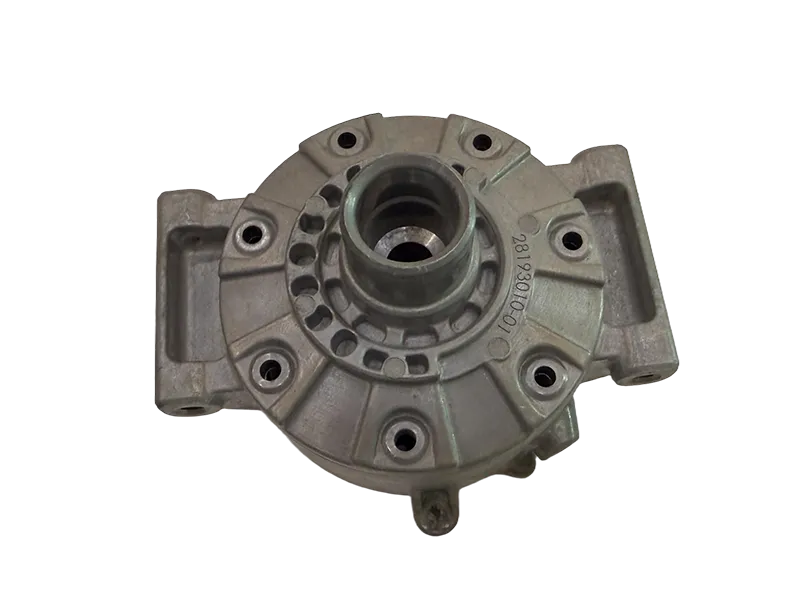
Case Overview
This case involves a front cover of a fuel vehicle air conditioning compressor (also known as the front cylinder head), which is a critical housing component of the fuel vehicle air conditioning compressor system. The component is installed at the front end of the compressor body and, together with the rear cover, forms the main compressor housing. It is used to accommodate moving components such as the crankshaft, piston, and scroll mechanism, while also providing sealing for high-pressure refrigerant.
In fuel vehicle air conditioning systems, the compressor is driven by the engine through a belt. The refrigerant is compressed inside the compressor into high-temperature and high-pressure gas before entering the condenser for heat dissipation. The front cover serves as the front sealing barrier of this high-pressure circuit, and its air tightness directly affects the cooling efficiency of the compressor and the service life of the complete system.
Part Information
| Part Name | Fuel Vehicle Air Conditioning Compressor Front Cover (Front Cylinder Head) |
| Application Industry | Fuel Vehicle Air Conditioning System |
| Material / Grade | ADC12 Aluminum Alloy |
| Product Dimensions | 162 mm × 134 mm × 101 mm |
| Product Weight | 790 g |
| Average Wall Thickness | 5 mm |
| Manufacturing Process Combination | Die Casting |
| Surface Treatment Process | Shot Blasting |
| Quality Inspection Method | X-ray Inspection (Non-destructive Testing) |
ADC12 Material Characteristics
ADC12 aluminum alloy is the die casting alloy selected for this project. Its main chemical composition and mechanical properties are as follows:
Chemical Composition: Si 9.6%-12%, Cu 1.5%-3.5%, Mg ≤0.3%, Fe ≤1.3%, Zn ≤1.0%, balance Al
Tensile Strength: 220-240 MPa (achievable with rheo-die casting process)
Elongation: 0.8%-1.2%
Hardness: ≥90 HBW
Density: Approximately 2.68 g/cm³
Feature: Good fluidity and filling capability, suitable for complex thin-wall housing components with a good balance between performance and cost.
Core Challenge: High-Pressure Air Tightness Requirement
The fuel vehicle air conditioning compressor front cover is a critical sealing structural component. During operation, it continuously withstands refrigerant pressure, and its sealing performance directly affects the reliability of the air conditioning system.
If defects such as pores, shrinkage cavities, or micro cracks exist inside the casting, they may be exposed in the sealing area during subsequent machining processes and form continuous leakage paths, resulting in refrigerant leakage and affecting the normal operation of the compressor. Meanwhile, refrigerant leakage can also reduce the cooling efficiency of the air conditioning system and affect the long-term stability of the vehicle air conditioning system.
Due to the characteristics of the die casting process, including high-speed molten metal filling and rapid solidification, factors such as residual gas in the cavity, gas entrapment during metal filling, and solidification shrinkage may cause internal defects. Once these defects connect with the sealing area, they may become leakage paths for high-pressure refrigerant.
Solution
To address the challenges of air tightness, internal density, and complex structure forming of the fuel vehicle air conditioning compressor front cover, this project adopted a combined process solution of:
Vacuum-Assisted Die Casting + Local Squeeze Feeding + Gating System Optimization
to improve the internal quality of the casting and the reliability of critical areas.
1. Vacuum-Assisted Die Casting
To address potential porosity issues during the die casting process, a vacuum venting system was designed inside the mold cavity to reduce the residual gas content inside the cavity before and during injection.
Main optimization measures include:
- Installing a vacuum venting system to improve cavity exhaust capability;
- Reducing the risk of gas entrapment during the filling process;
- Optimizing the venting path to improve filling quality in complex areas;
- Improving the internal density of the casting.
Through vacuum assistance, gas entrapment during aluminum melt filling was reduced, minimizing the impact of porosity defects on product air tightness.
2. Local Squeeze Feeding Technology
For thick-wall hot spot areas such as mounting bosses, bearing seats, and threaded hole bosses of the front cover, squeeze pins were installed at corresponding positions in the mold.
During the solidification process of the aluminum melt, localized secondary pressure was applied to the semi-solidification area for feeding compensation, improving the material density in thick sections.
Main measures include:
- Installing squeeze pins in critical hot spot areas;
- Applying directional feeding compensation for local thick-wall areas;
- Improving feeding performance during solidification shrinkage;
- Reducing the risk of internal defects such as shrinkage cavities and porosity.
This process effectively improves the internal quality of ADC12 aluminum alloy die castings and enhances the sealing reliability of the compressor front cover.
3. Gating System Optimization Design
According to the complex cavity structure of the compressor front cover, the gating system was optimized accordingly:
- Positioning ingates preferentially in thick-wall areas to improve feeding capability in thicker sections;
- Filling complex and difficult-to-vent areas first to control cold metal and gas flow direction;
- Optimizing runner and overflow design to improve mold temperature distribution;
- Combining venting channels and vacuum vent blocks to ensure orderly discharge of cavity gas.
Through the combination of gating system optimization and vacuum-assisted technology, the forming stability of complex structural areas was improved and the risk of internal defects was reduced.
Case Summary
Through the combined process of vacuum-assisted die casting and local squeeze feeding, this case successfully addressed the strict high air tightness requirements of the fuel vehicle air conditioning compressor front cover.
| Key Technology | Problem Solved |
| Vacuum Die Casting + Vacuum Vent Block | Reduced residual gas inside the cavity, lowered porosity, and improved filling quality |
| Local Squeeze Feeding (Squeeze Pins) | Eliminated shrinkage defects in thick-wall hot spot areas and improved density |
| ADC12 Material Selection | Provided good fluidity, mechanical properties, and cost-effectiveness |
| Shot Blasting | Improved surface hardness, increased residual compressive stress, and enhanced fatigue life |
| X-ray Inspection | Ensured internal quality compliance and met defect level requirements |
