
 English
  Arabic
  French
  German
  Italian
  Russian
  Spanish
 CNC Turning is a transformative machining technology widely used to produce cylindrical components with unparalleled precision and efficiency. As a cornerstone of modern manufacturing, CNC Turning integrates computer-controlled automation to produce high-quality parts for industries ranging from automotive to aerospace and medical devices. This article dives deep into CNC Turning, exploring its processes, machinery, tools, materials, applications, and optimization techniques.
Introduction to CNC Turning

CNC Turning is a subtractive machining process in which a cutting tool removes material from a rotating workpiece to achieve the desired shape. This operation is typically carried out on CNC lathes or turning centers, which are programmed to execute precise movements with minimal human intervention.
- Precision Machining: Capable of achieving tolerances as tight as ±0.001 mm.
- Versatility: Handles a wide range of materials, including metals, plastics, and composites.
- High Efficiency: Ideal for both high-volume production and custom machining.
Why CNC Turning is Essential
CNC Turning ensures repeatability, consistency, and exceptional surface finishes, making it indispensable for industries requiring high-quality components.
CNC Turning Process
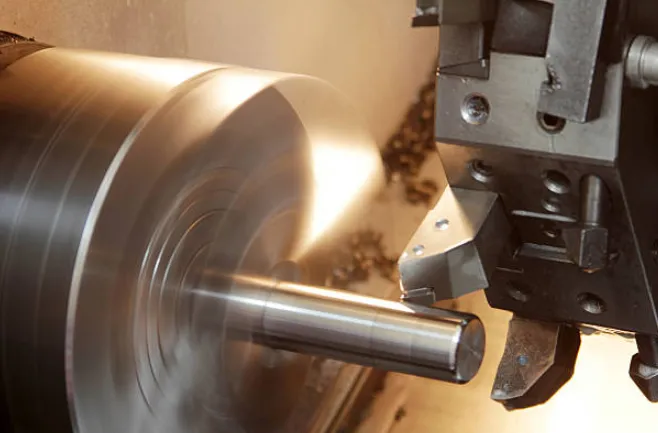
From Here
The CNC Turning process involves multiple stages, each critical to achieving the final product’s precision and quality.
Workpiece Preparation: The raw material is selected and securely mounted in the lathe using chucks or collets.
Programming: CNC programs are created using CAM software or manual G-code programming to guide the machine’s movements.
Machining: The lathe rotates the workpiece while cutting tools remove material to create the desired geometry.
Inspection and Quality Control: The finished part is inspected for dimensional accuracy and surface finish using precision measuring instruments.
Types of CNC Turning Machines
CNC lathes and turning centers come in various types to cater to diverse manufacturing needs.
| Machine Type | Features | Applications |
| Standard CNC Lathe | 2-axis control (X and Z axes) | Simple cylindrical parts |
| Swiss Turning Center | Supports slender workpieces with high precision | Small, intricate parts like medical implants |
| Multi-Tasking Machine | Combines turning, milling, and drilling | Complex parts requiring multiple operations |
| Vertical Turning Lathe | Ideal for large, heavy workpieces | Aerospace and automotive components |
Tools Used in CNC Turning

The choice of tools significantly impacts machining performance and part quality.
- External Turning Tools: Shape the outer diameter of the workpiece.
- Internal Tools (Boring Bars): Create internal cavities and boreholes.
- Threading Tools: Cut threads on both internal and external surfaces.
- Parting Tools: Separate finished parts from the raw material.
Tool Materials
| Machine Type | Features | Applications |
| Standard CNC Lathe | 2-axis control (X and Z axes) | Simple cylindrical parts |
| Swiss Turning Center | Supports slender workpieces with high precision | Small, intricate parts like medical implants |
| Multi-Tasking Machine | Combines turning, milling, and drilling | Complex parts requiring multiple operations |
| Vertical Turning Lathe | Ideal for large, heavy workpieces | Aerospace and automotive components |
Materials for CNC Turning

CNC Turning can handle a broad spectrum of materials, each with specific characteristics and applications.
Metals: Aluminum, steel, brass, titanium, copper.
Plastics: ABS, PVC, acrylics, nylon.
Composites: Carbon fiber and fiberglass.
| Material | Advantages | Applications |
| Aluminum | Lightweight, corrosion-resistant | Aerospace, automotive, electronics |
| Steel | Strong, versatile | Structural components, industrial tools |
| Brass | High machinability, corrosion-resistant | Fittings, decorative items |
| Titanium | High strength-to-weight ratio | Medical implants, aerospace parts |
| Plastics | Lightweight, flexible | Consumer products, insulating components |
Factors Influencing Material Choice
- Machinability: Ease of cutting and shaping.
- Cost: Material cost relative to project requirements.
- Mechanical Properties: Strength, ductility, and hardness.
Applications of CNC Turning
CNC Turning is a versatile process used across numerous industries:
Automotive
Produces components like shafts, bushings, and piston rods with high dimensional accuracy.

Aerospace
Creates lightweight, high-strength parts like turbine blades and engine components.

Garden Machine

Manufactures surgical instruments and implants with precision and reliability.
Electronics

Produces connectors, housings, and miniature parts for advanced devices.
Why Choose CNC Turning
Precision and Consistency
CNC Turning achieves exceptional accuracy and repeatability, essential for industries like aerospace and medical manufacturing.
Efficiency and Productivity
- High-Speed Machining: Delivers faster production rates while maintaining quality.
- Automation: Reduces human error and labor costs.
Flexibility
- Supports a wide variety of materials and part geometries.
- Easily adaptable to both small-batch and mass production.
Challenges in CNC Turning
Despite its advantages, CNC Turning comes with challenges:
Heat Generation
Excessive heat can lead to tool wear and material deformation. Cooling systems and heat-resistant tools mitigate this issue.
Tool Wear
Frequent tool replacement is necessary for maintaining machining quality. Coated tools like carbide with titanium nitride prolong tool life.
Dimensional Variations
Proper machine calibration and stable setups are essential to avoid deviations in part dimensions.
Conclusion
CNC Turning is a cornerstone of modern precision manufacturing, offering unparalleled efficiency, flexibility, and accuracy. By employing advanced tools, optimized techniques, and a wide range of materials, CNC Turning has transformed industries and continues to drive innovation in manufacturing.
If you are looking for CNC Turning Service, Scojet is always here to help!




